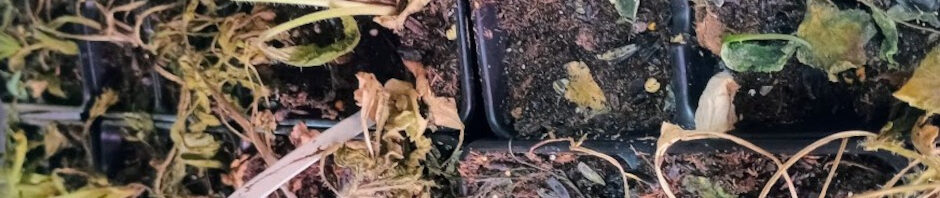
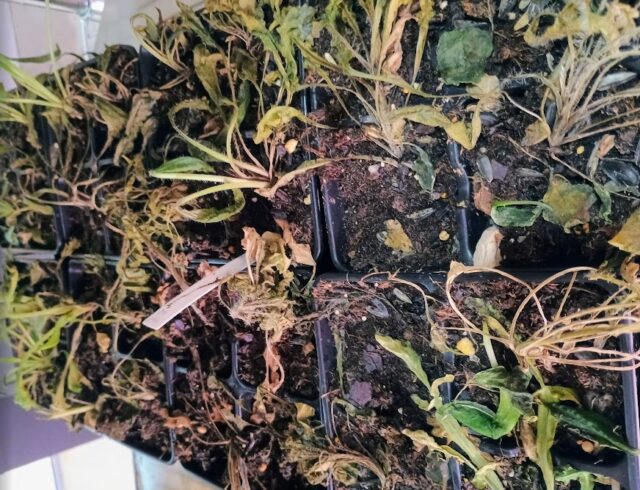
I would love to report that the battle is mine! That would be a lie. Everyday when I go down and check there are spider mites, mostly on the same plants. Watching while flats of growing things melt into dust can take the wind out of even the most optimistic person’s sails.
Weekends are always more challenging because Bill is off work and we tend to do more things outside. The seedlings don’t get checked and that often leads to problems. Over night the dirt will go bone dry and everything will fall over and look dead. Then we water but when things look like that we over water, which is just as bad. Often I go back down on Monday to find things floating. Each day I check and they are still a soggy mess until they aren’t. One day they will be bone dry again there is no happy medium.
Pests love people like us. Those extremes are a dinner bell ringing for miles around. These plants can’t fight back!
My bi-focal/flashlight trick has really been helping me to find mites that I had been missing. Each day I check and when I find them I spot treat that plant. After I have checked all of them I then go back and spray the entire flat. I have even been spraying the plants that look totally dead and there are several flat in that condition. My thought is, maybe they can come back and maybe if there are mites and by chance they fall in that dead flat maybe the spray will still kill them.
The first week of Jack’s Dead Bug there were still mites. I told myself that’s okay because the label does not say it is for mites. The white fly, however, looks like it might be gone. (future me, they are not gone)
Week two with Neem Oil Insecticidal Soap/Captain Jack’s Insecticidal Soap (I’ve used both) no more white fly but there are still mites. Update, three days after I wrote this I found white fly on the petunia again. She was covered, not as bad as it’s been but a lot more than I had expected.
Today I found mites on the Mexican Sunflowers on a top rack all by themselves. They had been sitting by the Butterfly Weed, which were hit hard by the mites. I had checked the sunflowers before moving them and they looked okay but over the last few days I noticed that some looked like they were dying. Today I saw mites.
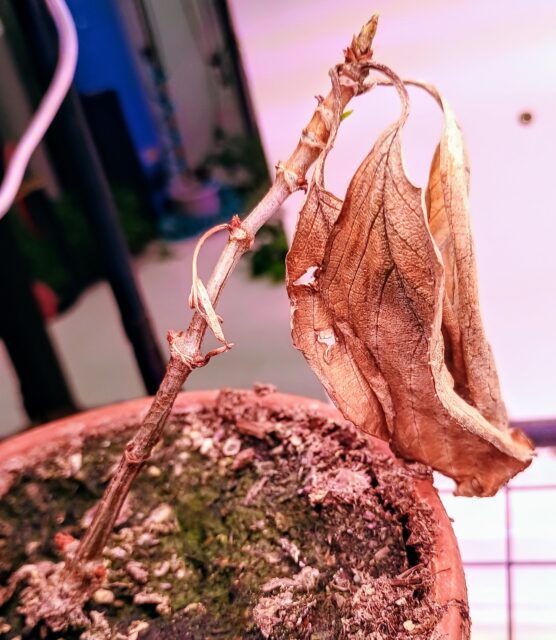 The begonia that I had saved from a cutting last fall looked dead. When I first found the mites the entire plant was covered in web and all the leaves were dead or dying. Over the past two weeks I have started to see new growth from the tip. I have also seen mites on that new growth, until today. Over the course of the last 3 or 4 days I have not been seeing new mites. Fingers crossed she might make it!
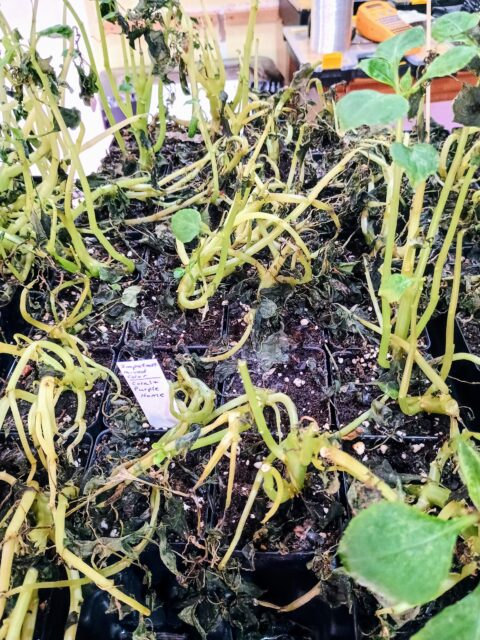
The Impatiens who were hit the hardest still look awful and I’m still finding mites. Up till today it had been a small web here or there but today one of them had it’s entire head covered in web. It happens so fast and the damage is so extensive.
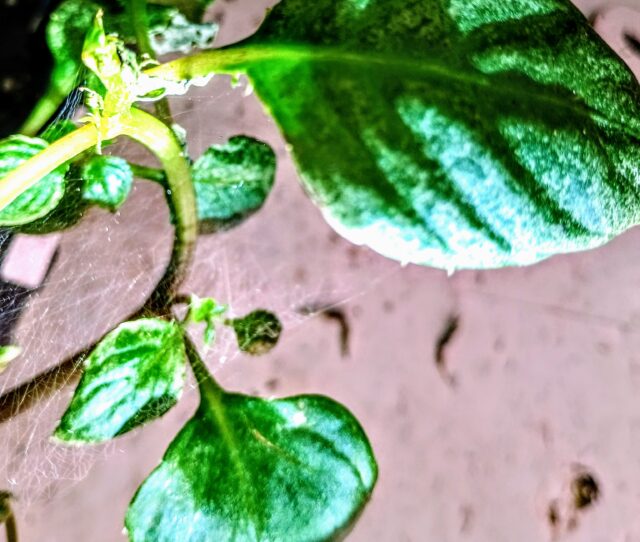
This impatien is on the flat on the bottom shelf of the rack. They had not been as extensively damaged but last week this is where I found the web covering the entire top of a plant and today, 4 days later, I found this large web. Bear in mind these have been spot checked everyday and when I find something I spray it. On top of that the entire flat along with every other plant was completely sprayed every 2 days. In the very beginning the plant was held upside down and hosed off in the sink. Here we are starting week 3 and this is still happening. We were just down there yesterday watering and checking and did not see this. I saw it today by accident, the flashlight caught a wisp of web just as I was standing up. I had to hold the light just right in order to see web. It was completely invisible. I edited the photo to enhance it so that you could clearly see just how big this web was.
There are 5 flats of Impatiens on this rack and it’s doubtful that any of the plants will survive. That’s 360 plants gone in weeks.
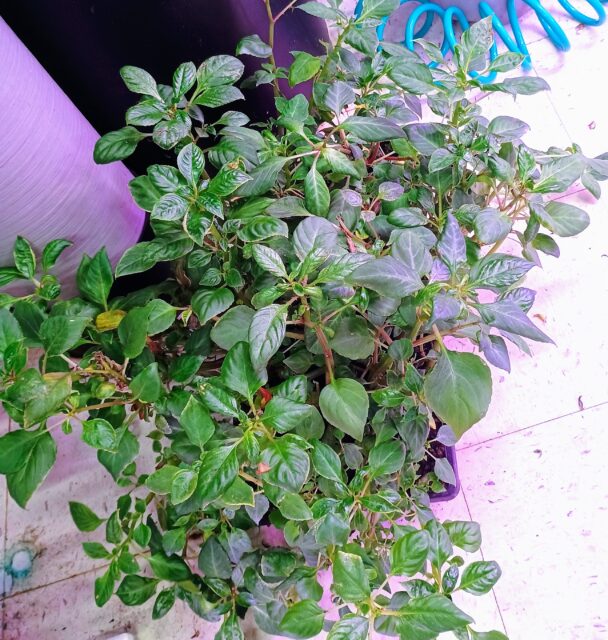
This flat did have mites but not nearly as bad as the other flats, I caught it in time. It has been sitting in isolation for several weeks and it’s looking pretty good. While it is sad that so many will not make it I also don’t usually buy flats and flats. I will wait and if they go on clearance I will buy some when they hit .50 cents but that is always late in the year. This year I will plant these out and then collect seeds and start more then plant those out. The net effect should be the same not so many early on but by mid season the front of the house will be covered.
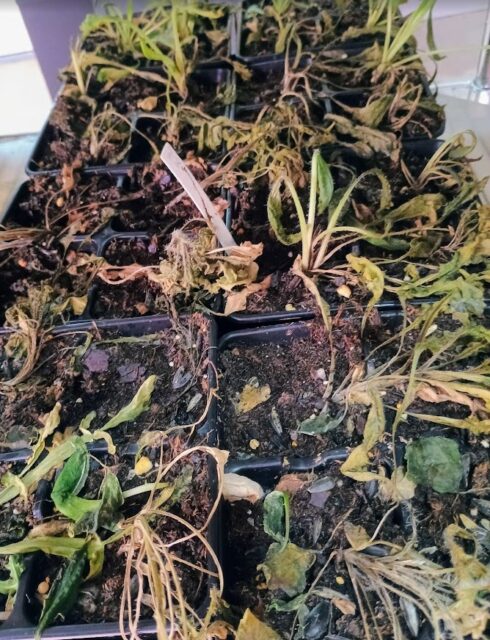
These are my Shirley Poppies and all 3 flats look pretty much like this. If I get one poppy out of the entire lot it will surprise me.
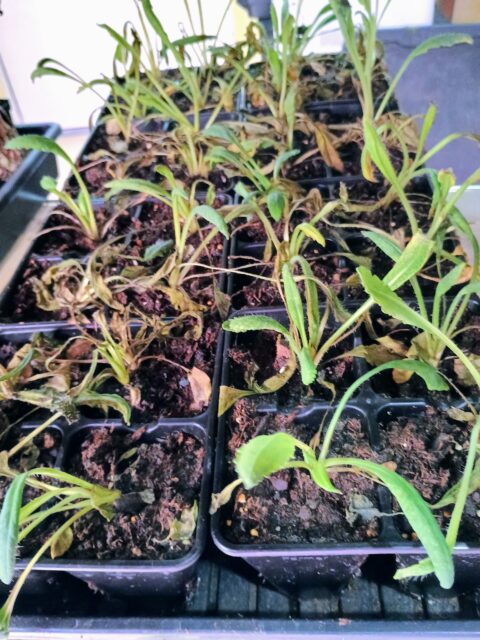
These are the Red Poppies and while they look sad and not all of them will make it I think I might get a full flat from the two I started with.
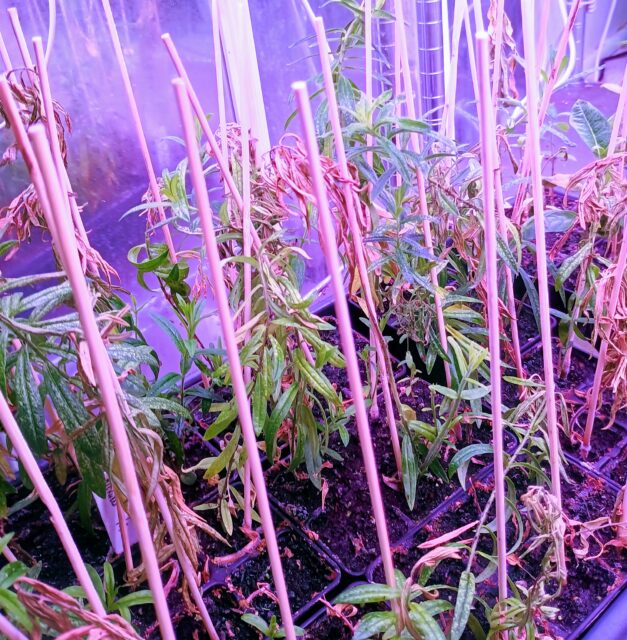
The Milkweed, collected from seeds locally, got hit hard and I lost a lot of them. The ones that are remaining don’t look great but one plant is one more that we had so cheers!
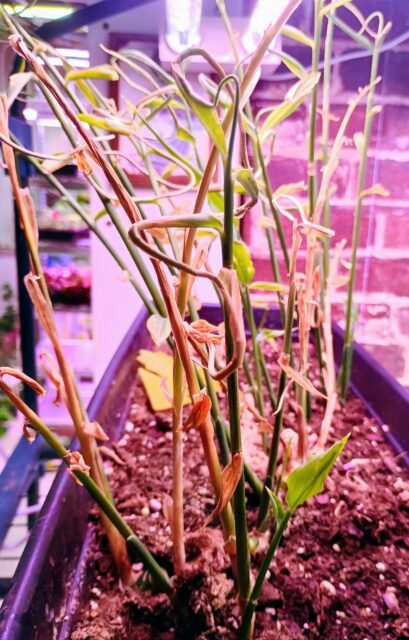
This is my ginger, started from Sam’s Club ginger root, I frankly was surprised that the mites hit it. I had a theory that mites liked frond leaves and soft juicy leaves, in my mind ginger did not fit either of those. Yet there it is sad and dying. I kept finding webs on them. I have started some more ginger in a different room and you can see here, there are fresh stems coming up and I have not seen mites in a few days. Maybe she will make it.
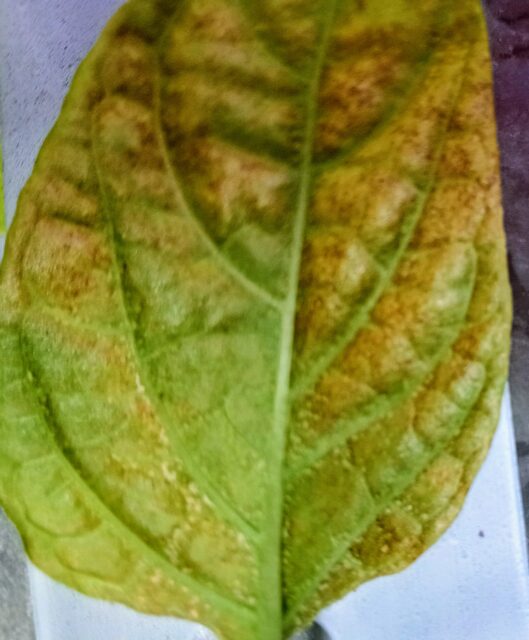
This was probably my saddest discovery today. The pepper plants looked great and I up potted them last week. Since then they have not looked great. I told myself it’s because I had two plants per cell and I pulled them apart. The stress of that, plus the stress of being up potted are the reason they don’t look good they will recover. The leaves have that yellow veining and a copper hint which made my stomach flip. I turned over a couple of leaves and saw small bumps with an almost powdery look. I can’t make out what they are but my fear is those are mites. No webbing yet, but sick plants.
I found myself getting very discouraged today. But it was easier to snap out of it. I knew going into this it would not be quick. At the very least it would be 6 – 10 weeks of spraying every 2 – 3 days. If nothing else this has taught me that skipping even one spray day could be the difference between a plant living or dying. While I would like to just take all the infected plants outside and dump them and call it a loss, I won’t. The reason is, this is a great opportunity to learn. Learn what works. Learn how long it takes. Learn what happens when you skip a day. Learn why I always lost this battle. Learn how quickly a small problem can take over and how quickly plants will die. Learn what certain products do, if they are effective, and the correct application of them. Learn that even when I don’t think there should be ANY reason to check for pests, check for pests and start treatment immediately. Treat everything.
It’s discouraging but I knew going into it that it would be a long fight. In the past I’ve lost everything. This time the damage seems to be staying limited to certain flats. If I can keep it from spreading and even kill the mites totally, then I will be sad for my losses but happy for my new found knowledge.
This third week will start the less than organic attack. Bill is interested in what Pyrethrin will do and wants me to bump that one to next. I’m interested in what Malathion will do. That being said after more research into Malathion I think I will only use it on the flowers. None of them will be going outside for a few weeks so pollinators won’t be impacted. While I know that Malathion is used by cities for mosquito control, it’s used in agriculture, it’s the MOST common chemical agent used here in the US. I still would rather not eat it. I also know it will break down and nothing in the basement will be eaten by people or animals for weeks yet, but I don’t know. One of our biggest reasons for growing a garden, is to reduce the number of unknowns we ingest. Luckily the mites seem to have limited themselves to the flowers.
Information about Malathion:
When I first heard about this it was via a Youtuber. She was spraying boxwoods which would not impact pollinators. I’ve seen sites that indicate that it can kill bees and so other pollinators as well. Would I want to spray this outside on food or flowers? I don’t think so but I don’t know maybe it would depend on how bad the problem was and if I could do it at night and if I found enough documentation to show that pollinators would not be impacted. Would I spray it on food? I don’t think so, maybe on ornamental pumpkins if I found out it killed squash bugs and vine bores. Never on lettuce or leafy green plants we eat or on herbs. Even on plants where we eat the fruit or veggie of that plant I think I would want to find another solution. This one does stay active in the plant so you don’t have to repeat it frequently. There are even cons to applying frequently because if a bug survives it might build immunity.
Long and short this is something people use on our bodies to treat lice. It’s used to kill pests in parks and playgrounds. It’s used by agriculture to spray fields. It’s sprayed from trucks and sometimes by air craft to treat mosquitoes in cities. It’s been around for a very long time.
We have also seen big declines in pollinators and how do you prove what the direct cause was? Would I use it outside, I hope not. Will I use it indoors, keep the pets away, wash my hands, spray only the house plants and flowers, will I wait to put those flowers outside? The answer to all of those is yes. Would I recommend that you use it? No. I would recommend that you do your own research and then make a decision based on the facts that you have and on your situation. In the end that’s the best any of us can hope to do.