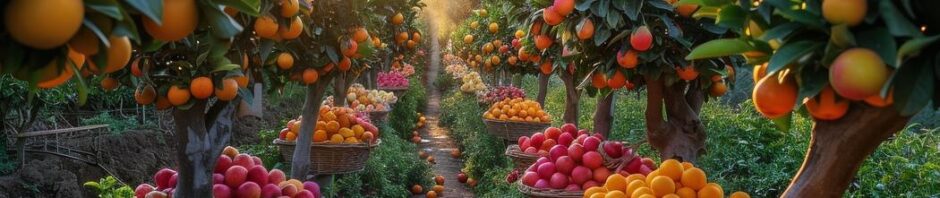
I have dreamed of having a yard filled with edible delights for years. My vision was to have vegetables, fruit trees, berry bushes, grapes, and flowers all living together in a happy yard filled with the sound of birds and humming bees dappled in golden sunshine, sigh. I think I might be a hobbit.
Over the years we planted some. It started with some raspberry starts from a friend. We planted them by the barn. When that burned down so did my raspberry plants. We purchased some and planted them up by the house, added blackberries, and sprinkled strawberries under them just for fun. They have done okay. At some point we added some raspberries with wicked thorns. It was so bad I stopped even harvesting the berries for fear of bleeding to death. Last year I cut all of them out, leaving only the thornless blackberries. We talked about moving them to the berry part of the garden but they are very established and looking good. When we dug up the ones across from the shop we lost them all in the move. I’m thinking these big guys will stay right were they are we will just make the trellis look prettier.
In a previous post I talked about this new orchard part of the garden and some of the trees we were hoping to add. Some of that changed on Saturday when we sat down together and started to look at trees. It did get overwhelming but after figuring out a lot about rootstocks and finding some charts that laid it all out things got much easier. For instance, the size of the tree, from dwarf to full size, is determined by the rootstock. But also things like disease resistance are also a factor in the rootstock. Finding orchards that sell what we were looking for was tricky. The last thing I want is to become a gatekeeper on someone’s orchard dreams. I’m going to put the charts in here and links to the different websites we bought from or got decision making information from but don’t let that make it seem too complicated. The biggest thing is find your spot where you want your tree(s). Don’t be afraid to try a fruit you have never heard of before. Don’t just stay with a McIntosh apple because it’s a name you know. Don’t just run to the local big box store, take your time to find the tree(s) that best fit your goals.
Here we go, starting with apples, the Mehrabyan Nursery website is a good resource and where this graph came from. 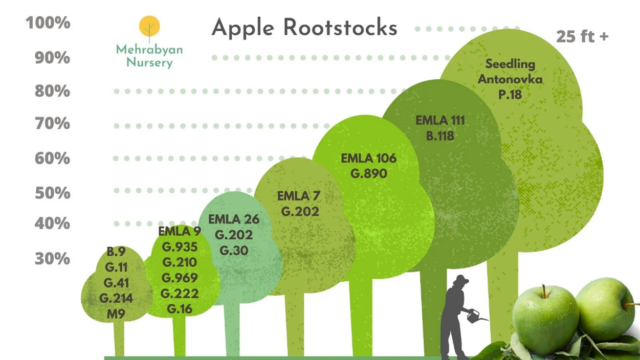
The cherry rootstock graph also came from here.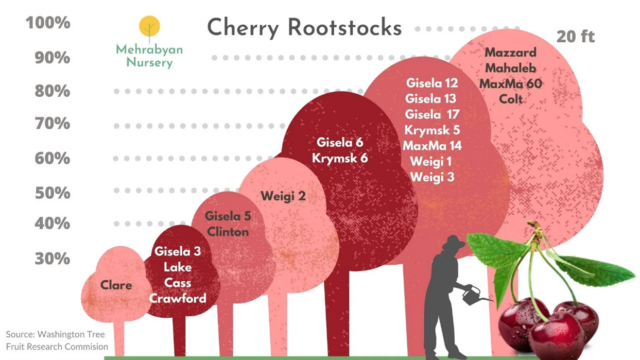
These two graphs helped it make sense and helped us to narrow down the trees we looked at. We could search specifically for the rootstock we wanted. On the websites we only looked for the rootstock we wanted not just the “type” of fruit we wanted. For instance Ambrosia apples are Bill’s favorite. We found sites that sold the Ambrosia, the next thing we looked for was what rootstock had they grafted that apple variety to? If the site didn’t tell us or they didn’t offer the rootstock we wanted we moved to the next site.
- Black Ice Plum Tree – Myrobalan Dwarf rootstock, needs a pollinator
- Toka Plum Tree – Myrobalan Dwarf rootstock, self pollinating will pollinate the Black Ice
- Garnet Girl Cherry Tree – Gisela rootstock, dwarf, self pollinating
- Reliance Peach Tree – self pollinating, semi dwarf
- Liberty Apple Tree – B.9 rootstock, dwarf (will pollinate the Ambrosia)
- Ambrosia Apple Tree – B.9 rootstock (will pollinate the Liberty)
We also are adding 3 columnar apple trees to the middle area in front of the house. Jung Seed sells a 3 tree combo. Roots to Fruits Nursery also sells 2 different kinds of columnar apples. 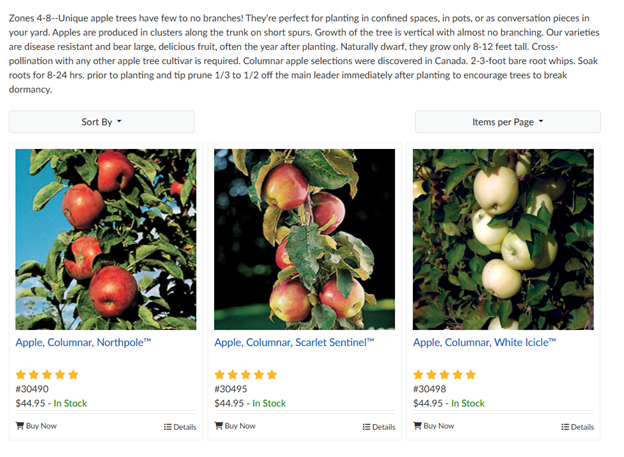
We ordered 6 fruit trees from Roots To Fruits Nursery located in WI for a total of $246.00. If you sign up for their email newsletter you get a 10% off code. Shipping to us added another $57. They also offer a pick up option.
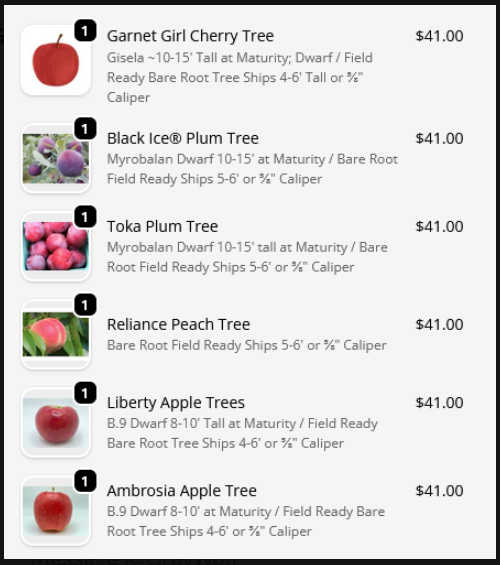
There were several things that I really liked about this website. First, in the world of greenhouse/nursery websites they have done an excellent job of not just saying, “we have stuff call us to find out what!” Instead, they listed what they had AND they gave information on that page about that item plus links to more detailed information on what things mean. If any item is available in a different rootstock they offer drop-down menus so you can pick the rootstock you want. Many items can be purchased in different sizes, and they are clear about what they can ship and what you must come pick up. We picked Field Ready Bare Root for all our trees. While some were available in smaller sizes for as little as $19. Only 2 trees that we selected were available in the smaller sizes. To keep our start as uniform as possible we upgraded to the Field Ready size on those 2. We had wanted or expected to need two of each variety in order to get pollination which would have increased our startup costs as well as the amount of effort needed to get them all planted and ready. Having self-pollinators is nice because we can make the jump into our mini orchard faster, with less space, and less startup cost. On a further encouraging note, the reviews that we read about this nursery were all positive.
Jung Seed, another Wisconsin family owned company was where we placed our next fruit tree order.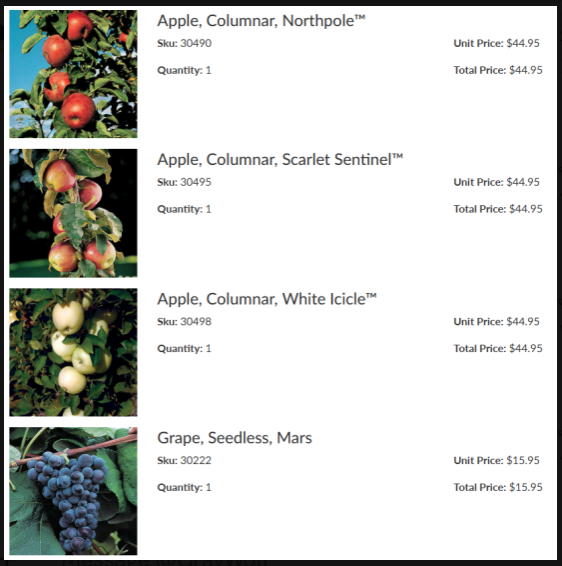
We were able to get free shipping on this order but the “extra” grape cost as much as the shipping would have. It was worth it we want to expand the grape area too. I think Bill emailed them asking to add an additional tree (they have a dwarf Lapin) but I don’t know if he has heard back. Why did we split the order between these two? Root to Fruits only offered 2 different kinds of columnar apples and we knew Jung offered 3.
We still want to get fig trees and when we do they will either go in the middle area with the apples or they will go between the front garden boxes. I know we want to do at least two of them. We still need to run the fencing in the new garden area to protect the orchard. One of the things I’ve been hearing is a main reason fruit trees fail is deer and rabbit pressure. I’m pretty sure we did lose four of our original fruit trees because of that. More than likely we lost all the original apples that we planted down in a clearing off the trail through the woods. The trees planted in the middle area won’t have a fence around them and we do get deer that come right up to the front door to eat the landscaping. We will start them by at least protecting their trunks with wire and then watch to see if we need to do more. Oh who am I kidding these things will be my babies I’ll probably put a fence up.
The process and what we learned
I felt overwhelmed numerous times trying to figure out what we were going to grow up here. There was a huge learning curve for me. It’s not just about a type of fruit; it’s also about the rootstock that fruit is grafted to if it is grafted. You also need to know what trees need to be pollinated and what other types of trees will pollinate them. You can’t just say, “I have a pear, let’s get two so they can pollinate each other.” Sometimes pollination just doesn’t work like that. I thought I knew what trees I wanted to get until we started getting even deeper into the details. In the end we did go with the Black Ice Plum and added the Toka Plum for pollination. They are both Dwarf with the Myrobalan rootstock but a little taller than I was hoping for topping out around 15’. We also went with the Reliance Peach, though my first choice was the Red Skin Peach. The Reliance peach tree tops out at 15’ and I believe it is not grafted. The surprise was the cherry; I had picked the Lapin. After doing more research we found that the Lapin was not going to be correct for up here it gets bigger than we had hoped, 17’-21’ tall. There is a dwarf version available from Jung topping out at 12’-15’. There are smaller cherry tree/bushes getting no taller than 4’ – 5’ tall/wide. These were all tart cherries, and we were looking for a sweet cherry, hopefully I can still bake pies with them otherwise we may need to add a tart cherry bush somewhere into our berry fun world.
The process involved finding the charts, which laid out what the rootstock definitions were. With that knowledge, we started doing searches for the size of tree we wanted based on rootstock . This was easier but still confusing. We would find one website that had a certain tree with a certain rootstock we were looking for. But nothing else we wanted. After you have looked at 29 different websites and found 1 type of tree on each things start to blend in your mind. On top of that we did not want to purchase 1 tree from 29 different websites. You pay for shipping, plus it’s a lot more moving pieces to keep track of and you want to make sure that each seller has a good track record of selling and delivering healthy trees.
Then Bill found the Roots to Fruits Nursery site. They had rootstock info and just about every tree we were looking for at reasonable prices. We still needed to do some additional internet searching to find out information about pollinators and disease/pest resistance but the biggest part of the job was done. We had enough information to feel pretty good about the trees we were ordering and the companies we were ordering from.
The Rootstocks on the trees we selected
Apple Tree Rootstock – BUD 10
https://www.grandpasorchard.com/Tree/Malus-BUD-10-clonal-rootstock
Plum Tree Rootstock – Myrobalan
https://www.grandpasorchard.com/Tree/Prunus%20rootstock-Myrobalan-seedling-rootstock
Cherry Tree Rootstock – Gisela (series) https://extension.oregonstate.edu/catalog/pnw-619-sweet-cherry-rootstocks-pacific-northwest
While Gisela 3 was the only one listed in the chart on Grandpasorchard there are also 5,6, 12, 13 & 17. It appears that each root stock not only varies in height but also what kind of soil they prefer. Since the cherry we selected did not list which variant it is we are growing a little blind.
Peach – not on a rootstock
I cannot find any indication that the Reliance Peach we selected is grafted it looks like it is its own stock and a true Dwarf. Although on the largish side peaks at between 10‘-15’. We thought we could get the Ambrosia apple and Red Skin peach from a Tractor Supply about an hour away. However, we could not find what rootstock they used. Some websites do not list the rootstock they might just give a height. Gurney Seed is an example of that. Some websites have proprietary items which make it impossible to find out more information about that tree. We found that with Stark Bro’s Nurseries. Know that the search filters on these websites are not perfect. We would search for B9 and nothing would come up. Yet when you looked at the trees it would clearly state they were grafted to the B9 rootstock. You could even search on the word “Dwarf” and have nothing come up yet in the NAME of a tree it would say Dwarf.
While I wanted to give up at times and just go get what we could find I’m glad we didn’t. Once you get into the whole world of grafting and typing and zones it’s interesting and not as frustrating as I had thought. Finding what you’re looking for when you are being specific about what you want IS challenging. Finding everything you want on a single website is incredibly difficult. Finding what you want at a price you want makes it even more difficult. In the end I’m so glad we took our time and decided to approach this like we do most things. List your requirements. Start compiling data, keep track of that data for later reference and take your time to understand. Today we were lucky and in the process of compiling data we found a website that not only provided information but also had the products we were looking for.
We started like this:
- Determine location.
- Height and width of the space in your goal location.
- In ground or in containers.
- Fruit for fun, fruit to sell, fruit for baking or eating, what’s the goal.
Now you can start looking for trees or bushes that match your goals:
- Look at the rootstocks available for that type of fruit determine which ones fit your space needs.
- Look at your zone to eliminate trees that will not thrive in your orchard.
- Look for pests and disease in your area and determine which trees will do better for you. If you don’t know then look for trees that are most resistant to common issues.
- Which fruits best fit what you want i.e. cooking or eating from the tree.
- Identify pollination needs and find compatible trees from your group.
Once you have a list of trees in the correct size, zone, vigor, pollination, and fruit use needs you can start searching for those trees and only those specific needs. Not all Stella Cherry trees are the same in habit, the rootstock can change everything. You search for Stella Cherry, then on that site you look for all the other criteria till you find a Stella that ticks all your boxes. Anything that says Stella cherry will give you a Stella cherry but not all the trees will grow the same, be right for your zone, or have a resistance to disease or pests that you need.
Understanding that was huge for us. While the hunt is frustrating the payoff is huge. Nobody wants to get a tree expecting it to be 8’ and it ends up getting 25’ tall. Don’t let the sheer amount of variables and information turn you away because you can do this. Finding the right sites that give help you to make a good decision is crucial. Going into it knowing what you want and what space you are working with will help you to succeed.
We got our first 2 pears last year from 1 of the 3 pear trees that managed to stay alive. They have been there for around 10 years or so and we did nothing to help them. Last year was the first year we tried to help them and they rewarded us with fruit. Growing things isn’t about being perfect you just have to plant something and keep trying.