
I’ve never had great success growing melons. Sam was the first person to grow an actual watermelon here. From a seed that was in a piece of melon from the grocery store. He was excited about it and asked if he could plant it. Bill and I said sure and he plopped it in the ground right in front of the house. As the summer wore on that little seed just kept growing into a beautiful plant and then formed an actual melon which we enjoyed that fall. Not in a million years did I expect that. I have attempted to grow them every year. I have carefully tended to them, I’ve started them directly in the ground, I’ve started them in the house, I’ve put them in tilled gardens, I’ve put them in low raised beds, I’ve put them in low raised beds and then stapled wire over them to keep critters out, I’ve put them in tall raised beds, I’ve tried them in multiple different locations and I’ve tried many different kinds of seeds. From time to time I’ve gotten small melons with little taste but nothing has even been as good as that random seed that Sam planted. So what have I learned?
I’ve learned to not give up and to lean into enjoying the process without needing results to find joy.
I’ve also learned that melon and cucumber seedlings smell exactly like what they are which is probably why the forest hones in on them. Certain seeds and seedlings smell delicious which is why planting them directly into the ground is dangerous. I have spent summers going out each morning to find my seedlings laying on the ground, or just gone. I replant the ones I can and the next day it happens all over again until I have nothing left to replant and it is to late in the season to keep trying. I have stapled screen to the boxes to prevent the plants from being dug up. I came out to find the entire box flipped up and the plants gone. I moved them into a more, what I thought protected, area only to find that the slightly taller boxes closer to human dwellings did absolutely nothing to deter plant predators. So we fenced in more area but didn’t have a gate, same story. Added a gate but didn’t realize that we had a highway sized hole going under the back fence. The cats showed the husky where the escape hatch was which resulted in a romp through the woods in pursuit of said husky, it also resulted in the hole getting fixed. Last year was the first year that the seedlings stood a chance. We grew some lovely plants, the cantaloupes did better than the watermelons. Here is what I learned:
- I got my plants out to late. They were already starting to flower and looking lanky. Apparently if they flower before planting if they produce fruit it will be small and tasteless. Gary Pilarchik, The Rusted Garden, did a video that, you can find here on how to grow watermelon. He is in a different zone than us and he goes into a lot of detail but the big take away for me was get the seedlings in sooner.
- I don’t feed them enough. While they go into good soilless medium with fertilizer I just don’t fertilize enough after they are in. We did much better this year because Bill extended the watering line and he was doing fertigation in that system every few days. I just don’t think it started soon enough after planting on top of the plants being to mature when they went in.
- I was either watering to much or not enough and definitely not enough when they first went in so their root systems just didn’t have what they needed to establish.
- Cantaloupes will go up better than watermelons. The watermelons did go up the trellis but they just never seemed to thrive and again this might be because of how old the plants were when planted.
- Protection from birds is important. Once the birds discovered that the cantaloupes’ were delicious the race to get them was on, most of the time I lost.
- Temperature is everything. I thought it was hot, the melons did not. Part of the reason I believe that the cantaloupes’ did better than the watermelons was that they were warmer. All of the plants were planted right next to the metal walls of the shop. But the one corner gets more sun and then radiates that back to the melons during the night so that corner is consistently warmer. Those melons all did the best.
- Weed competition is a battle melons might not win. The watermelons were all planted in pots that I cut the bottoms out of and set on top of the ground in the main garden. The issue is that the ground in there is covered in strawberry plants, mint, raspberries that refuse to be moved, and weeds. The cantaloupes’ were all in boxes with little to no weed competition.
 I later added bush bean seeds to those boxes in front of them and there were flowers in front of them BUT the front of those boxes gets hammered with water from the gutters when it rains. This means that it’s really hard to grow. You can see the two boxes where the cantaloupes’ were last year here in this picture. This year we have sunflowers in there. The melons in the first box seemed to do the best. That box is right on the corner of the shop and pretty much full sun. The next box was sometimes shaded by the umbrella and also the gutter was damaged above it so maybe it took more of a hit when it rained. Past the boxes you can see a wall of green. That wall is where the watermelons had been, it’s easy to see how they just had to much competition to do well.
 - Seed matters. Between the two boxes of cantaloupes the store seed did better than the seeds we saved from last years melons or store melon. The saved seed germinated and when the plants went in those seedlings actually looked better than the seedlings from seed packets bought that year. As the season went on the seedlings from the packets got better and better and the saved seed plants seemed to all die or not thrive.
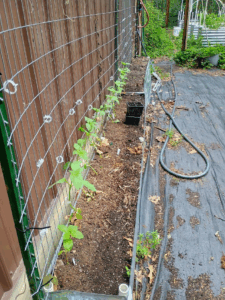 I later added bush bean seeds to those boxes in front of them and there were flowers in front of them BUT the front of those boxes gets hammered with water from the gutters when it rains. This means that it’s really hard to grow. You can see the two boxes where the cantaloupes’ were last year here in this picture. This year we have sunflowers in there. The melons in the first box seemed to do the best. That box is right on the corner of the shop and pretty much full sun. The next box was sometimes shaded by the umbrella and also the gutter was damaged above it so maybe it took more of a hit when it rained. Past the boxes you can see a wall of green. That wall is where the watermelons had been, it’s easy to see how they just had to much competition to do well.
So with all that in mind and because we had purchased a larger poly tunnel last fall I decided to try growing melons in there. A big part of that decision came from Charles Dowding, No Dig Gardening, How To Grow Melons in the UK, you can find the video here.
We do get warm here in Indiana and we do get humid. My question was do have those conditions consistently for the time that melons need? This year it was a cool/wet spring we have had our first high temp weeks here in mid June. Because we put that poly tunnel up I was able to move the melon seedling outside into it. 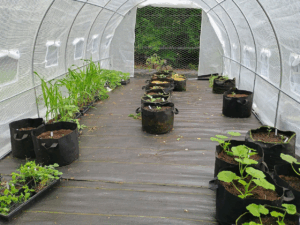 Then fill the bags and get them in their final home. The whole time they stayed in that tunnel where it got warmer sooner and stayed warmer even when the evenings cooled down. Plus the water could be better controlled and they were planted in bags with a high percentage of compost with fertilizer. While the poly tunnel doors are either open or closed which will not keep pests out I had bought a fine white mesh which I put over the doors. The backside is almost up against the outside fence so I completely covered that opening, no need to go in or out. I also put a watermelon bag in front of it. The other door I covered in two pieces that overlap, easy to get in and out but enough of a barrier to stop birds and many insects from barging right in.
I took a page out of Charles Dowding’s book and lined my watermelon bags on the outside walls and put a line of cantaloupes down the center. 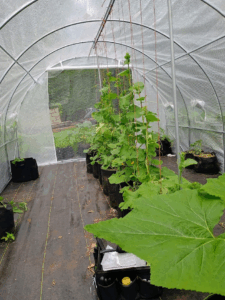 In most of the watermelon bags there are two plants. Each one of these plants will trail on the ground in opposite directions. The cantaloupes’ will go up. We tied string to the bag handles and then to metal conduit at the ceiling height. We choose not to tile directly to the main beam in the tunnel just in case that weight would cause a problem. Instead we took the system we had in the back garden from a previous year and repurposed it. It is tied to the main tunnel beam but it also has legs. In weeks the plants are almost 7 feet tall and every other day we have to reweave them around the string to keep them going up. They are also flowering! I need to rewatch the video because I know that the side shoots need to be removed and I thought he topped them at some point but I can’t remember the hows and whys. The varieties we selected do not need pollination so no worries about that. Although we do have some bugs which find their way in like lightening bugs and a few moths/butterflies.
There was a seedling mix-up in one of the cantaloupe bags, a stray squash made it’s way in. Even though I planted way to many squash this year I didn’t have the heart to pull it. We decided to use it as an experiment plant to see if it fares better than the ones just outside of the poly tunnel. The whole thing might be a miss because I put two plants in each bag which might be over crowding and that could lead to reduced air flow or not enough fertilizer to go around. Watching the No Dig video it was mentioned that melons do not like to be pushed around by the wind outside they would have that pressure but this year the tunnel will protect them from that even though it has windows and large doors. One of the other points made was that when grown on the ground cantaloupes’ may produce fruit later, not as large, and not as many as when they are grown vertically. As if to prove his point he had at least one plant growing on the ground and he compared that to the ones growing vertically. So why grow the watermelons on the ground? I dunno.
We have grown pumpkins up over trellis as well as winter squash and it works. 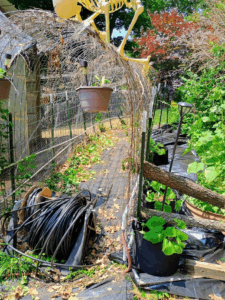 A big difference is that pumpkins and winter squash vines will root along the vine but melon vines don’t. So while we still grow some pumpkins on the arch we are also growing some where they and the winter squash can sprawl out on the ground. The vine bores or squash bugs might kill a main stem but maybe if they have rooted further down the plant might still survive. One thing I have noticed this year is that over on the trellis the first two plants started out on the ground. On those two plants I am finding squash bugs and their eggs on the leaves but on the rest of the plants which went up over the trellis they seem to be pest free. Which is another reason I like growing them up, it makes checking leaves so much easier. We are testing that with the summer squash too.
 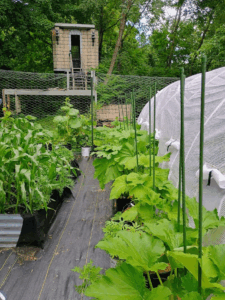 While you cannot grow them up per say you can tie them to a stake creating a more vertical plant. These plants have been tied up now for a few days. Initially they looked silly but the leaves “fix” themselves over time. Before pulling them together and tying them to the stakes that entire path was covered and I was breaking leaves dragging a hose over them and Tas was stepping on them. Will it be easier to check leaves for pests? We shall see. Will it create more air flow to help reduce mildew? We shall see.
 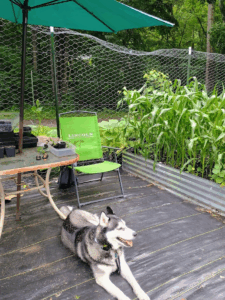 For now things seem happy and at the very least keeping it all up and tidy means that the dog can zoom around without me yelling because he isn’t running over the plants and killing them. The corn here needs to have blood meal applied BUT until we get fence we can’t do that. EVERYTHING is attracted to blood meal. We ended up getting the fencing this past weekend and put the blood meal down, plus some additional general fertilizer. Immediately Smokey, the shop cat, was over at the box looking for a way in. Tas just likes to go over and nibble on the corn leaves so the fencing protects them from his grazing.
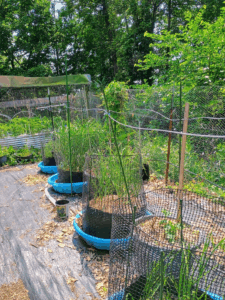 | 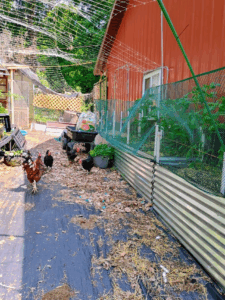 |
We fenced in the boxes, tubs and pools because of chickens, the dog, and the cats. We realized that the cats were killing many things by laying in them, digging, or going potty. For sure the chickens were devastating anything they get into. It makes things harder and more expensive but also easier and less stressful or frustrating when you figure out what works for you regardless of if it works for someone else.